
Tu carrito
No hay más productos en tu carrito
Can I use last year’s sunscreen?
This post is also available in:
In the middle of summer, sunscreen becomes an essential part of our daily routine. But when we reach for our beach bag or start packing for our holidays, we may come across a sunscreen that was left unfinished from the previous summer. And the question arises: can we still use it? Does it retain its properties and protective efficacy?
The answer does not depend solely on how much time has passed. The period since opening, storage conditions and the condition of the formula are all key factors to consider.
To address this question, we spoke to Dr José Luis Barbosa, aesthetic medicine physician, who shares his professional perspective on sunscreen storage and the factors we should consider before using a product again.
Table of contents
How long does sunscreen last once opened?
The first step in determining whether we can continue using a sunscreen is to check its PAO (Period After Opening).
You will find it on the packaging, represented by an open-jar symbol accompanied by a number and the letter M — for example, 6M, 9M or 12M. This indicates the recommended period of use after opening, provided the product has been stored under appropriate conditions.
For example, a PAO of 12M indicates that the product should be used within 12 months of opening.
So, when we find a sunscreen left over from the previous summer, the question should not simply be when we bought it, but when we opened it.
A simple tip can help: write the month and year of opening on the packaging. This makes it easier to check whether the product is still within the indicated period of use.
However, the PAO is not the only factor we need to consider. How the sunscreen has been stored during those months also matters.


Why does the way we store sunscreen matter?
UV filters and the other components of a cosmetic formula have a defined stability. The product has been formulated and evaluated to maintain its characteristics for a specific period of time and under appropriate storage conditions.
However, excessive heat, direct sunlight or unsuitable storage conditions can affect the stability of the formula.
This is particularly relevant for sunscreens. During the summer, we often take them to the beach or pool, leave them inside a bag for hours or even forget them in the car, where they may be exposed to very high temperatures.
If the formula has deteriorated, its photoprotective efficacy may be compromised and the product may no longer provide the level of protection against ultraviolet radiation for which it was formulated.
As a result, the skin may be more exposed to the effects of UV radiation, including sunburn, photoageing and cumulative skin damage.
Therefore, even if the product is still within its PAO, we should also ask ourselves: how has it been stored?
How can I tell if my sunscreen is still in good condition?
In addition to checking the PAO and considering how the product has been stored, we should also examine the product itself.
A formula that has undergone changes may show visible or noticeable signs of deterioration. These are some of the signs to look out for:
- A change in colour compared with its original appearance.
- A different smell from usual.
- Changes in texture or consistency.
- Phase separation, with different layers visible in the formula.
- The presence of lumps or a noticeably different application.
- Damaged or deformed packaging.
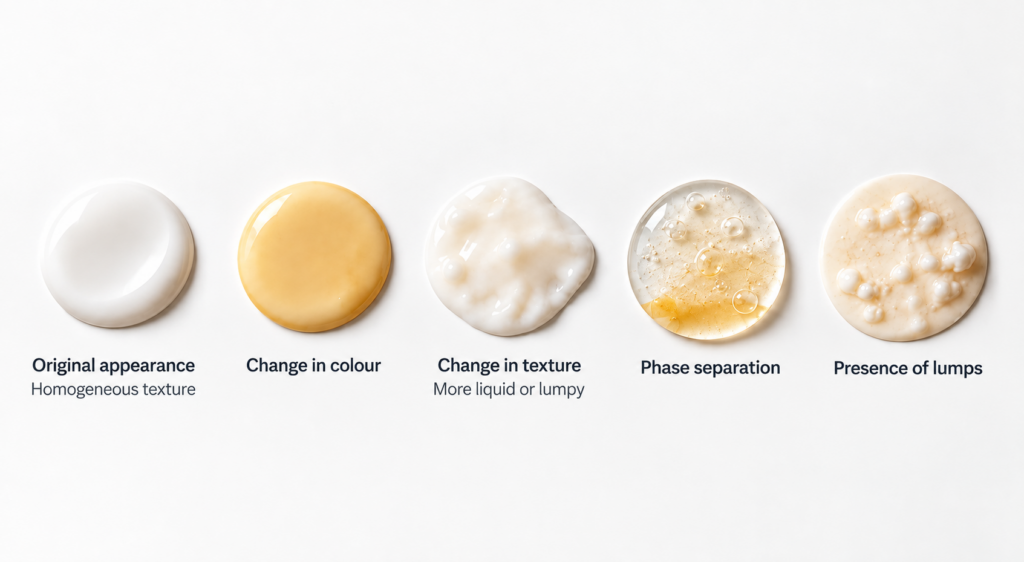
If you notice any of these changes, it is advisable to stop using the sunscreen and replace it with a new one.
However, there is one important point to remember: just because the product appears to be in good condition does not necessarily mean that all of its properties remain intact.
This is why we need to consider three factors together: PAO, storage conditions and the condition of the formula.
So, can I use last summer’s sunscreen?
It depends.
If the product is still within the PAO indicated by the manufacturer, has been stored correctly and shows no signs of alteration, the fact that it was purchased or used during the previous summer does not necessarily mean that it needs to be discarded.
However, if it has exceeded its PAO, shows changes in the formula, or we do not know whether it has been exposed to high temperatures or unsuitable storage conditions, it is advisable to replace it.
When it comes to sun protection, it is not worth assuming that a product continues to provide the same level of protection if there are doubts about its condition.
How should sunscreen be stored correctly?
The way we store sunscreen is particularly important during the summer months.
To help preserve the characteristics of the formula:
- Avoid exposing it directly to sunlight. At the beach or pool, keep it in the shade whenever possible or protected inside a bag.
- Do not leave it in the car for prolonged periods. The temperature inside a vehicle can become extremely high during the summer.
- Close the packaging properly after each application. This helps reduce the product’s contact with the external environment and prevents water, sand or other elements from getting inside.
- Store it in a cool, dry place when it is not being used.
- Keep the packaging and applicator clean, particularly after using the product at the beach or pool.
- Make a note of when you opened it. A small note with the month and year can make it much easier to keep track of its PAO.
Do you have any questions?
If you would like more information on this topic or would like to send us a question, you can contact us at monicavazquez@skinclinic.com, indicating the title of the article in the subject line.
Our team will be happy to help.

