
Tu carrito
No hay más productos en tu carrito

Can you use retinol during summer? A complete guide to avoid common mistakes
This post is also available in:
Retinoids, such as retinol and retinal, are among the most scientifically supported active ingredients in dermatology. Their ability to stimulate epidermal renewal, promote collagen synthesis, and improve multiple signs of photoaging has made them a cornerstone of anti-aging treatment.
However, every summer the same question arises: Should you stop using retinol or retinal when sun exposure increases? The answer is simpler than it seems: not necessarily. The use of retinoids does not depend on the season, but rather on the condition of the skin, the intensity of sun exposure, and the appropriate adaptation of the skincare routine.
Retinol in summer: what does dermatology say?
Does retinol cause dark spots or is it contraindicated during summer? This is one of the most frequently asked questions when warmer weather arrives—and also one of the most widespread myths in skincare.
Retinoids are not photosensitizing agents. In other words, they do not cause pigmentation or directly increase the damage produced by ultraviolet (UV) radiation.
What does happen is that they accelerate epidermal cell turnover and, particularly during the first weeks of use or when high concentrations are applied, they may cause a temporary disruption of the skin barrier.
This may manifest as:
- Dryness
- Flaking
- Redness
- Tightness
- Increased skin sensitivity
A compromised skin barrier is naturally more vulnerable to external aggressors, including solar radiation.
Therefore, the issue is not the retinoid itself, but rather using it when the skin is already irritated or failing to combine it with appropriate daily photoprotection.
4 Key tips for using retinol during summer
Most problems associated with retinol are not caused by using it during summer, but by using it incorrectly.
| Guideline | Purpose |
|---|---|
| 1. Always apply it at night | Retinoids are intended for the evening skincare routine. During the night, the skin activates its physiological repair mechanisms, allowing the active ingredient to work without exposure to environmental stressors. |
| 2. Keep the skin barrier well hydrated | Hydration not only improves skin comfort but also helps preserve the skin barrier and reduces the likelihood of irritation. Combining retinoids with repairing and hydrating ingredients improves skin tolerance and allows treatment to be maintained over the long term. |
| 3. Adjust the frequency according to your skin’s response | The effectiveness of a retinoid does not depend on applying it every day. If signs of irritation appear, temporarily reducing the frequency of application may be enough until the skin regains tolerance. In dermatology, consistency usually delivers better results than intensity. |
| 4. Use sunscreen every day | Daily photoprotection is an essential complement to any retinoid treatment. Applying a broad-spectrum SPF 50+ sunscreen every morning helps prevent photoaging, reduces the risk of hyperpigmentation, and protects skin that is undergoing continuous renewal. |
Which retinoid should you choose?
Not all retinoids have the same potency, and not all skin types have the same tolerance. The choice of formulation should be individualized according to skin type, previous experience with vitamin A derivatives, and treatment goals.
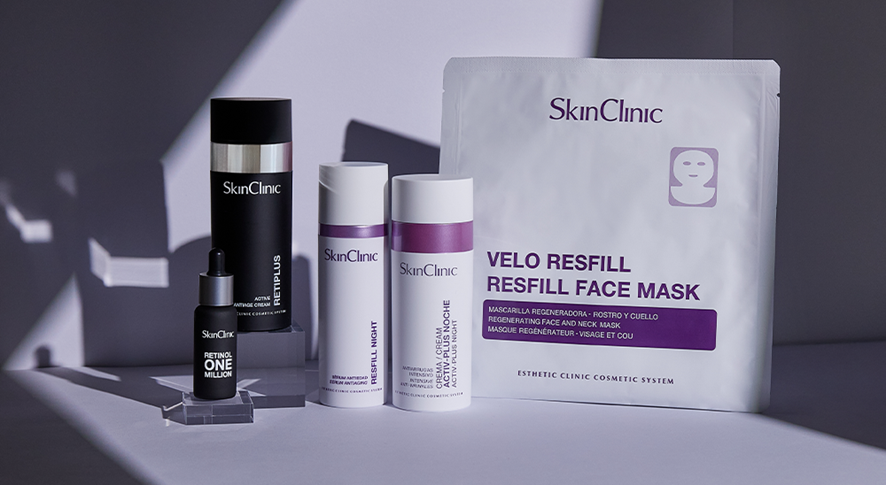
Activ-Plus Night
An anti-aging cream formulated for normal, dry, or mature skin. It combines retinoids with repairing and moisturizing ingredients to improve skin texture, firmness, and radiance while maintaining optimal skin comfort.
Resfill Night
A regenerating retinol serum designed to improve wrinkles, firmness, elasticity, and overall skin quality. Its combination of three molecular weights of hyaluronic acid, aloe vera, and antioxidant ingredients promotes smoother, more hydrated, and more even-looking skin.
Retiplus
A next-generation anti-aging treatment combining retinyl palmitate and encapsulated retinal, optimizing both efficacy and skin tolerance. It is particularly suitable for individuals who wish to introduce retinal into their skincare routine progressively and comfortably.
Retinol One Million
A concentrated retinol booster designed to personalize treatment intensity. It is mixed with your regular night cream, allowing the amount of retinol to be adjusted according to each individual’s skin tolerance and previous experience.
When should you temporarily stop using retinoids?
There are situations in which it is advisable to pause retinoid use until the skin barrier has fully recovered:
- Recent sunburn
- Severe skin irritation
- Active dermatitis
- Flare-up of rosacea
- Significant flaking
- Recent medical-aesthetic procedures such as laser treatments, chemical peels, or ablative procedures
In these situations, the priority should be restoring the integrity of the skin barrier before reintroducing the retinoid.
Summer does not require you to stop using retinol or retinal—it requires you to use them wisely.
Healthy skin is not achieved by interrupting treatment for three months, but by maintaining a consistent skincare strategy, respecting your skin’s tolerance, and combining retinoids with appropriate daily sun protection.

